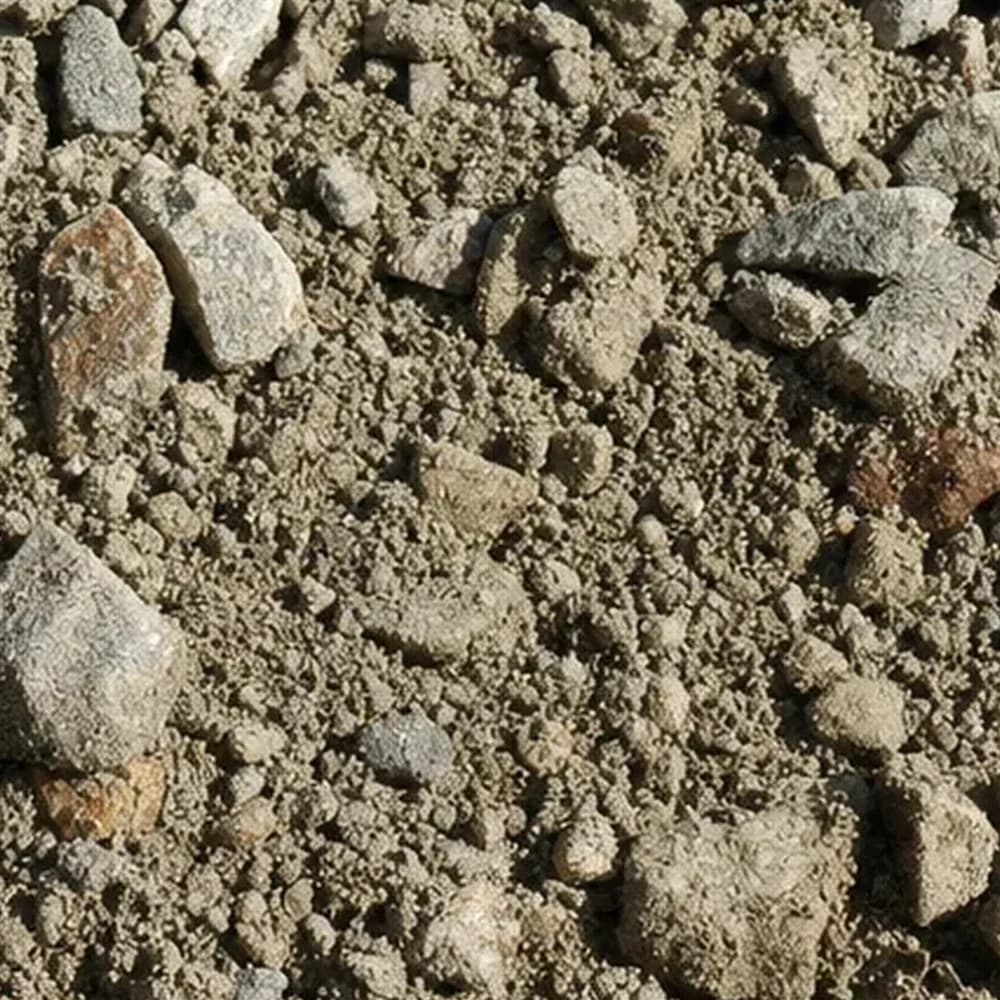
Crusher run calculator for South Dakota
A base course that packs into a pavement-like layer, figured at its finished compacted thickness rather than loose material.
Enter your project dimensions
After compaction, crusher run tightens 10-15% from its loose truck-load volume. Ordering only to the measured finished depth can leave the base half an inch short, so the calculator has a +10% allowance turned on. In South Dakota, it may be listed as Gravel Cushion, surfacing gravel, gravel surfacing, or 2 inch minus. These names describe crushed stone with fines included, weighing about 3,000 lb per cubic yard and packing into a surface that tires do not readily push aside.
Calculate for compacted depth
- For a lane, multiply its length by its width in feet. For a pad, use its overall dimensions.
- Enter the required compacted thickness: 4 inches for walkways and pavers, 4-6 for driveways, and 6-8 for truck traffic.
- Convert cubic feet to yards by dividing by 27, then multiply yards by 1.5 for tons. Leave the +10% setting on, since specifications refer to rolled depth rather than loose material.
Tons of coverage
| Compacted depth | 1 cubic yard covers | 1 ton covers |
|---|---|---|
| 2 inches | 162 sq ft | ≈ 108 sq ft |
| 4 inches | 81 sq ft | ≈ 54 sq ft |
| 6 inches | 54 sq ft | ≈ 36 sq ft |
| 8 inches | 41 sq ft | ≈ 27 sq ft |
Best uses and limits
- Driveways call for a compacted 4-6 inch base, followed by 2-3 inches of #57 or driveway gravel as the finished travel surface.
- For a lower-cost rural lane, crusher run by itself can form a usable crust. Plan for dry-weather dust and regrading every 2-4 years.
- For pavers and slabs, place 4 inches in compacted 2-inch lifts. Use the Paver Base Calculator for the entire paver assembly.
- Shed and hot-tub pads need 4 inches over stripped ground, increasing to 6 where soil is soft.
- Do not use it for a French drain. Its fines help it bind, but they retain water too. For drainage, use clean #57 or drain rock.
Example: a 20 x 10 parking pad
For 200 square feet finished at a compacted 4-inch depth, use 200 x 0.333 = 67 cubic feet = 2.5 cubic yards, which is 3.7 tons. Allowance brings the order to 4 tons. Place one half, compact it, then place the second half and compact again. Building in two 2-inch courses holds up longer than placing one 4-inch layer, especially through South Dakota freeze-thaw. A plate compactor rented for the afternoon is cheaper than fixing the first pothole. Skipping compaction shows up as ruts after the second delivery.
Delivery details
- Schedule the base stone and surface stone on the same delivery to keep work moving. Delivery is free either way.
- Have the load tipped at the end farthest from the entrance, then work material back toward it. On large pads, spreading downhill is easier than pushing uphill.
- Dampen each lift lightly before compaction. Crusher run packs visibly tighter when damp than when dry.
- Set aside a wheelbarrow-load for touch-ups. Crusher run is useful for filling potholes when they develop.
How pricing works
Because crusher run contains material straight from crushing rather than washed and graded stone, it is commonly used as an economical structural base. On a 4-ton order, the +10% allowance can help avoid arranging another half-ton delivery. Review the Crusher Run product page for the per-ton price, look at Road Base too, and arrange both driveway layers in one free delivery.
Crusher run, Gravel Cushion, surfacing gravel, and gravel surfacing questions
How much crusher run is needed for a driveway?
What does a yard of crusher run weigh?
How are crusher run and gravel different?
Are crush and run and crusher run the same?
Can crusher run serve as the top surface?
How much does crusher run shrink when compacted?
Other calculators
Base tonnage figured out.
Crusher run available by the ton with free delivery.